

James Stacey Taylor is an Associate Professor of Philosophy at The College of New Jersey. Branded a heretic by the London Times for his arguments in favor of legalizing markets in human organs in his book Stakes and Kidneys: Why markets in human organs are morally imperative (Ashgate, 2005) he is also the author of Practical Autonomy and Bioethics (Routledge, 2009), and Death, Posthumous Harm, and Bioethics (Routledge, 2012). He is the editor of Personal Autonomy: New essays (Cambridge University Press, 2005) and Death: Metaphysics and Ethics (Oxford University Press, 2013). He is currently working on a book on the ethics of using compensated donation to procure blood and blood products
In addition to his academic writing he has authored numerous Op-Eds on bioethical issues which have appeared in publications including the Los Angeles Times, the New York Daily News, and USA Today. (One of his award-winning Op-Eds for the Los Angeles Times was credited with influencing the ruling of the 6th District Court circuit that led to the legalization of payment for bone marrow.) He is an occasional contributor to National Public Radio and has been quoted in The New York Times.
James spoke to the CEC on Wednesday August 8, 2018. His topic was entitled “Kidneys, Votes, and Blackmail Information: What are the Moral Limits of Markets?”
 Robin Dale Hanson is an associate professor of economics at George Mason University and a research associate at the Future of Humanity Institute of Oxford University. He is known as an expert on idea futures and markets, and he was involved in the creation of the Foresight Institute’s Foresight Exchange and DARPA’s FutureMAP project. He invented market scoring rules like LMSR (Logarithmic Market Scoring Rule) used by prediction markets such as Consensus Point (where Hanson is Chief Scientist), and has conducted research on signaling.
 All club members and the guests at this meeting were given signed copies of The Elephant in the Brain. The club was able to get these books for the members from a grant from AIER.
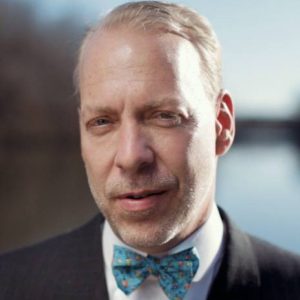 Jeffrey Tucker is editorial director of the American Institute for Economic Research, a managing partner of Vellum Capital, CLO of Liberty.me, Distinguished Honorary Member of Mises Brazil, economics adviser to FreeSociety.com, research fellow at the Acton Institute, policy adviser of the Heartland Institute, founder of the CryptoCurrency Conference, member of the editorial board of the Molinari Review, and author of eight books. In addition to 8 books, he has written 150 introductions to books and many thousands of articles appearing in the scholarly and popular press.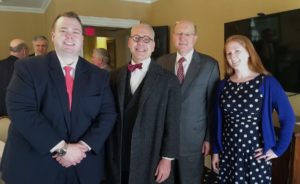
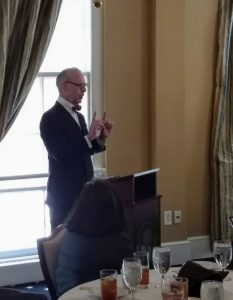
 Gerald P. Dwyer is a Professor and BB&T Scholar at Clemson University. He also is an Adjunct Scholar at the Cato Institute and a Research Associate at the Centre for Applied Macroeconomic Analysis at Australian National University. He was Director of the Center for Financial Innovation and Stability and Vice President at the Federal Reserve Bank of Atlanta from 1997 to 2012 and a Professor of Economics at Clemson from 1989 to 1999.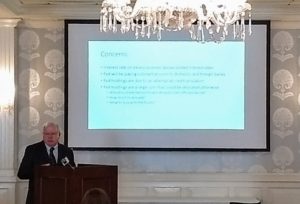
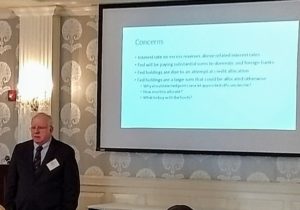
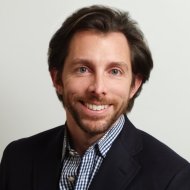 Marshall L. Stocker is an international investor recognized for his research on the relationships between political-economic policy and investment. With more than fifteen years of experience in the asset management industry, his perspective on policy has been sought by ministers, policy institutes, and investors in a wide-range of forums from decision-level policy discussions in Yemen to the syndicated Dennis Miller Radio show.Stocker has opined or been quoted in the Wall Street Journal, USA Today, New York Times, Washington Post, Financial Times, and Regulation Magazine. His seminal research “Equity Returns and Economic Freedom” was published in the Cato Institute’s Cato Journal and has been cited by numerous other academic papers. In his most recent written work, “Don’t Stand Under a Tree When It Rains”, he shares his perspective on life and business during the three years he lived in Egypt amidst the Arab spring.
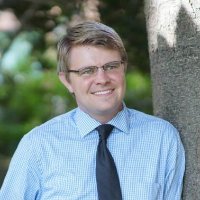 Greg Pulscher joined the Civitas Institute as a development associate in 2015. Since moving to North Carolina from Colorado, Greg established a networking social group in Raleigh devoted to liberty minded individuals, is a contributor to Opportunity Lives and created a podcast called “Free To Brew” tackling the misunderstood and widely criticized world of alcohol using a free market approach.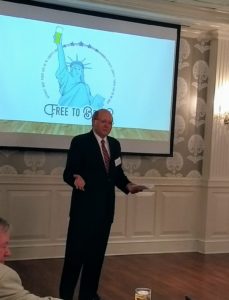

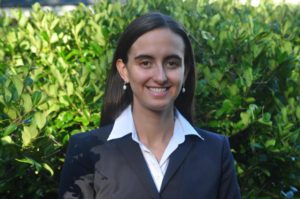 Dr. Beatriz Maldonado is an Assistant Professor of Economics and International Studies at the College of Charleston. Her research in economic development and political economics has appeared in the European Journal of Political Economy, Oxford Development Studies, Applied Economics Letters, and Social Science Quarterly.
 Dr. Todd Nesbit is a Senior Lecturer in Economics and Competitive Markets at The Ohio State University and an Adjunct Scholar at the Mackinac Center for Public Policy. Dr. Nesbit earned dual B.S. degrees in Economics and Mathematics from Capital University in 2001 and then went on to complete his Ph.D. in Economics at West Virginia University in 2005. Dr. Nesbit has authored peer-reviewed professional publications appearing in the Journal of Economic Behavior and Organization, the Southern Economic Journal, and Public Budgeting and Finance, among others. His primary research interest is in public policy issues generally, and excise taxation specifically.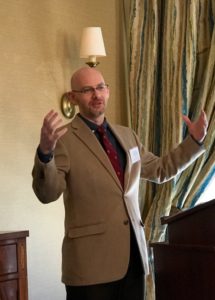
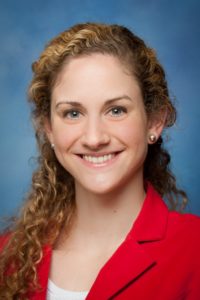 Katherine Restrepo is the Director of Healthcare policy at the John Locke Foundation. Before joining the John Locke Foundation, she interned at the Cato Institute under the direction of Michael Cannon, Director of Health Policy Studies.
 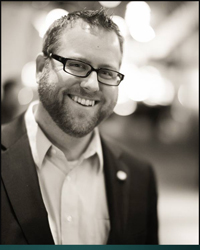 Since moving to the Charleston area in 1999, Brad DeVos has worked for two engineering firms and owned a consulting company. As an electrical designer and sustainability consultant he was involved in over 250 construction projects throughout the Southeast.